Sharing the Cup: How to Talk About Coffee Without Losing the Room
There is a particular kind of silence that falls over a table when someone describes their morning coffee as having "notes of red currant, bergamot, and raw cacao with a winey, anaerobic finish." It is not the silence of curiosity. It is the silence of people quietly deciding to change the subject.
Specialty coffee drinkers genuinely experience remarkable things in the cup. The flavors are real. The enthusiasm is earned. But the language we reach for—borrowed largely from professional cupping protocols and competition judging sheets—was never designed for kitchen tables or Sunday brunch conversations. When we use it anyway, we risk turning an invitation into a lecture.
The good news is that talking about coffee well has nothing to do with vocabulary size. It has everything to do with intention.
Why Coffee Jargon Creates Distance
Professional tasting language exists for a specific purpose: to give trained evaluators a shared, precise shorthand for describing sensory phenomena that are otherwise difficult to communicate consistently. Within that context, terms like "brightness," "body," and "terroir" carry real technical weight.
Outside that context, they often read as performance.
When you tell a friend that your Ethiopian pour-over is "florally aromatic with a tea-like body and high acidity," you are not describing the coffee to them—you are describing the coffee about yourself. The framing signals expertise rather than sharing experience. And most people, however curious they might be about coffee, will not ask a follow-up question when they feel the conversation has already moved past them.
The fix is not to abandon precision. It is to anchor precision in something universal: personal experience.
Start With the Familiar, Not the Technical
Every person alive has a flavor memory. The smell of a grandmother's kitchen. The taste of a childhood candy. The particular sweetness of a peach eaten in August rather than February. These memories are not lesser than formal tasting vocabulary—they are richer, more emotionally resonant, and far more likely to draw another person into a conversation.
When you taste something compelling in your cup, ask yourself: What does this remind me of? Not what it is called on the tasting notes card. Not what the roaster wrote on the bag. What, in your actual lived experience, does this flavor bring to mind?
A coffee that a professional might describe as having "stone fruit and jasmine" might remind you of the fruit stand near your office in late spring, or the iced tea your mother made from scratch. Say that instead. You will be surprised how quickly the person across from you leans in.
Practical Language Frameworks for Real Conversations
Here are three conversational approaches that work across different settings—from casual weekend mornings to more curious dinner-party exchanges.
The Contrast Frame Rather than describing a coffee in absolute terms, describe it relative to what your listener already knows. "This one is nothing like the dark roast you usually drink—it's almost lighter, more like tea in how it sits on your tongue." Contrast gives people a reference point. It also opens a door: now they want to know why it tastes different.
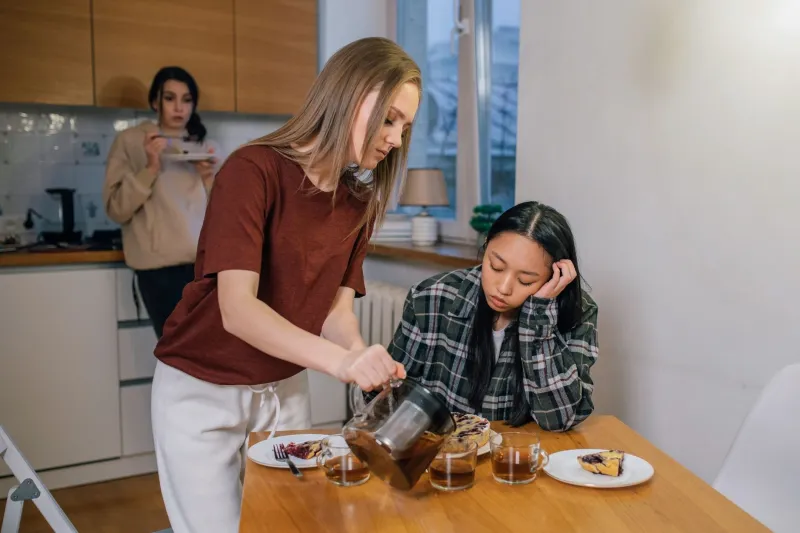
The Invitation Question Instead of delivering a tasting monologue, hand someone the cup and ask a simple, open-ended question: "What does this remind you of?" or "Does this taste sweet to you, or more like something else?" You are not testing them. You are genuinely curious about their experience. This reframes the entire dynamic—you are discovering together rather than explaining downward.
The Single Detail Pick one thing about the coffee that genuinely surprised or delighted you and lead with only that. "I keep noticing something almost citrusy right at the end—I wasn't expecting that." One detail is digestible. It sparks curiosity rather than overwhelm. If the other person wants more, they will ask.
When Someone Pushes Back
Not everyone will be immediately receptive to specialty coffee enthusiasm, and that is entirely fair. Coffee is personal. Some people have strong attachments to their existing routines, and a well-meaning recommendation can feel like an implicit criticism of what they already enjoy.
The most effective response to pushback is genuine curiosity rather than advocacy. Ask what they love about their current cup. Ask what they would change about it if they could. Listen without suggesting that the answer to every coffee preference is a single-origin light roast. Sometimes the most generous thing you can do is simply let someone enjoy their coffee on their own terms—and let your own enthusiasm speak quietly through the quality of what you brew when they visit.
Discovery, by its nature, cannot be forced. It has to be invited.
The Goal Is the Conversation, Not the Education
At its best, talking about coffee is not about transferring information. It is about sharing an experience—the specific, sensory pleasure of something brewed well, sourced thoughtfully, and tasted with attention. That kind of sharing does not require a glossary.
Maruyama Coffee's approach to sourcing begins with relationships—with farmers, with communities, with the particular conditions of a single hillside in a single harvest year. The same spirit applies to how we talk about what ends up in the cup. Real connection comes from specificity and honesty, not from the correct deployment of terminology.
The next time you brew something that stops you mid-sip, you do not need to reach for the tasting wheel. You just need to say: "You have to try this." And then let the coffee do the rest of the talking.