Gear You Own but Never Reach For: Rethinking Your Home Coffee Setup
The Cabinet That Tells a Story
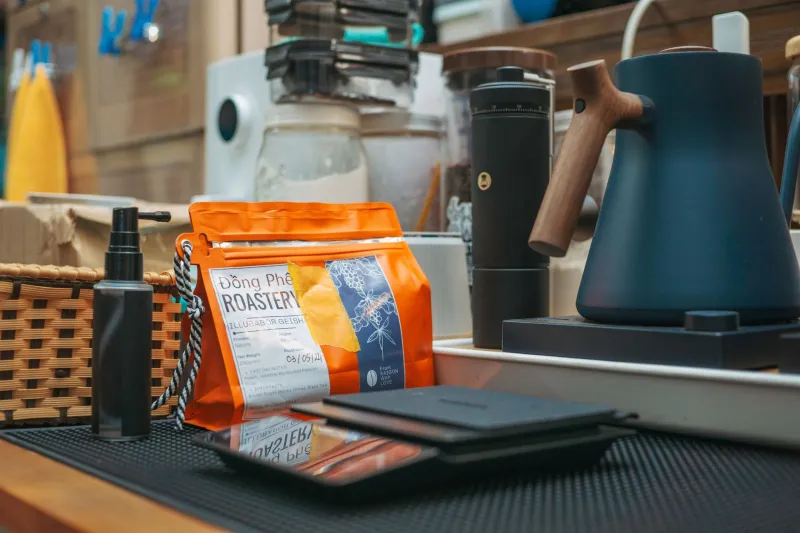
Open the coffee drawer — or the cabinet, or the corner of the counter that has quietly claimed itself as coffee territory — in almost any specialty coffee household across the United States, and you will find the same thing: a grinder that replaced a better grinder, a brewing device purchased after a persuasive online review, a scale with a dead battery, a gooseneck kettle still in its box. The accumulation is rarely the result of carelessness. It is, more often, the result of genuine enthusiasm meeting an industry that rewards curiosity with an ever-expanding catalog of tools.
The question worth asking is not whether you own too much equipment. The more useful question is whether what you own is actually working for you — or whether it is quietly working against the clarity and consistency that specialty coffee is meant to deliver.
Why Enthusiasts Accumulate
The psychology behind coffee equipment collecting is not difficult to understand. Specialty coffee, by its very nature, invites investigation. When a bag of single-origin beans arrives with tasting notes that reference stone fruit or dark chocolate, the natural impulse is to wonder what brewing variable might unlock those flavors more fully. That impulse leads to research. Research leads to a forum thread. The forum thread leads to a purchase.
This cycle is not irrational. Experimentation is genuinely how brewers develop skill and deepen appreciation for what a carefully sourced coffee can express. The problem arises when acquisition begins to substitute for practice. A new piece of equipment offers the feeling of progress without requiring the patient, repetitive work of mastering what you already own. It is far easier to order a new brewer than to spend two weeks dialing in the one sitting on your counter.
There is also a social dimension. In specialty coffee communities — both online and in local shop conversations — equipment literacy functions as a kind of shared language. Knowing the difference between brewing devices, understanding the distinctions between grinder burr geometries, being familiar with the latest releases from prominent manufacturers: these are markers of belonging. Ownership, in this context, can become entangled with identity in ways that have very little to do with what ends up in the cup.
The Honest Inventory
Before restructuring any brewing setup, it is worth conducting what might be called an honest inventory. This is not simply a count of items. It is an assessment of actual use.
For each piece of equipment you own, ask three direct questions. First: when did you last use this? Not when you intended to use it, or when you told yourself you would return to it — when did you actually brew with it? Second: what specific quality does this tool bring to my cup that my primary setup does not? If the answer is vague or aspirational rather than concrete and demonstrated, that is meaningful information. Third: does using this require a level of time or attention that I cannot reliably sustain on a typical morning?
That third question is particularly important and frequently overlooked. A brewing method that produces a transcendent result on a weekend afternoon when you have forty-five minutes and full attention may produce a frustrating, inconsistent result at six-thirty on a Tuesday. A setup that you actually use consistently will outperform a theoretically superior setup that you reach for only occasionally.
Distinguishing Tools from Distractions
Not all equipment accumulation is problematic. Some tools genuinely expand what a home brewer can achieve, and the distinction between a useful addition and a distraction is worth drawing carefully.
Tools that improve consistency — a reliable burr grinder, a scale that measures in tenths of a gram, a thermometer or temperature-controlled kettle — tend to earn their place because they reduce the variables that work against repeatability. When you source exceptional coffee, as Maruyama Coffee does through its long-standing relationships with individual farmers and specific lots, consistency in preparation is what allows the coffee's inherent qualities to express themselves clearly. Equipment that supports consistency supports the coffee.
Tools that expand your repertoire without replacing your foundation can also justify their presence. A second brewing device that produces a genuinely different flavor profile from your primary method — one that you actively choose based on the coffee you are brewing that day — is a deliberate addition. It reflects a developed palate and a clear intention.
What tends to function as distraction is equipment purchased in pursuit of a marginal improvement that, in practice, depends on a level of precision or ritual that your actual daily routine cannot accommodate. The gap between ideal conditions and real conditions is where most unused gear is born.
Building a Setup That Gets Used
The goal of a curated home coffee setup is not minimalism for its own sake. It is alignment — between what you own, what you actually do, and what the coffee you are brewing genuinely requires.
Begin with your primary method: the brewer and grinder combination that you reach for most mornings without deliberation. Invest in that pairing. Understand it thoroughly. Learn how it responds to different grind sizes, water temperatures, and pour techniques. The depth of knowledge you can develop about a single, well-chosen brewing method is considerably more valuable than shallow familiarity with a dozen devices.
From that foundation, consider additions only when a specific and demonstrated need presents itself. If you have begun exploring naturally processed coffees and find that a different brewer expresses their fruit-forward character more effectively, that is a concrete reason to expand. If you are simply drawn to a piece of equipment because it appears frequently in the feeds you follow, that is a reason to wait.
For equipment you own but rarely use, consider whether it belongs in your kitchen at all. Passing a brewer to a friend who will genuinely use it — or donating it to a community organization — is not an admission of defeat. It is an act of clarity that tends to improve both your space and your practice.
What Intention Actually Looks Like
At Maruyama Coffee, the sourcing process is defined by deliberate, long-cultivated relationships — an approach that prioritizes depth over breadth, and quality over accumulation. That same orientation translates meaningfully to the home brewing environment.
A counter with two or three tools used with real understanding will consistently outperform a cabinet full of equipment used with divided attention. The coffee you brew deserves that focus. The farmers who grew it, the processors who shaped its character, and the careful work that brought it from a specific hillside to your kitchen — all of that is best honored not by the sophistication of your equipment collection, but by the quality of your attention when you finally brew.
Open the drawer. Look at what is actually there. Then decide, honestly, what belongs.