The Label Between You and the Cup: Learning to Read Tasting Notes Critically
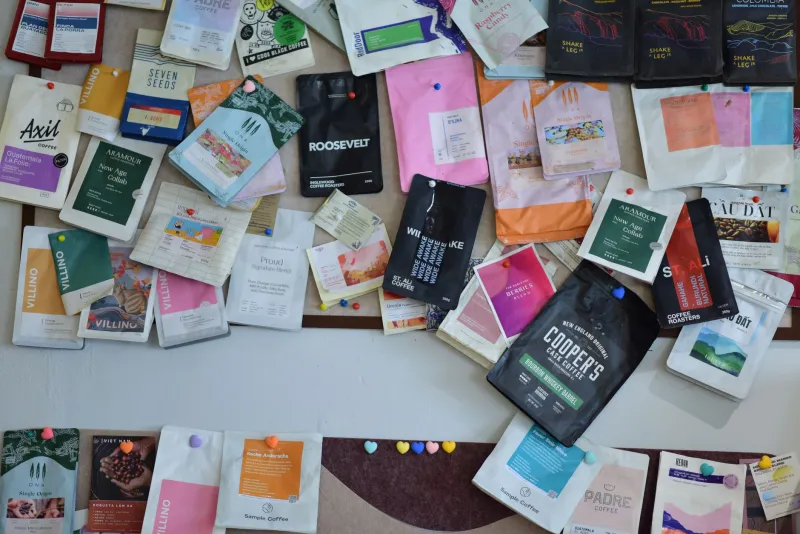
What the Bag Promises
Pick up almost any bag of specialty coffee sold in the United States today and you will find, somewhere on its surface, a short list of flavor descriptors. Dried cherry. Brown sugar. Bergamot. Meyer lemon. Toasted hazelnut. The language is confident, specific, and frequently poetic. It implies a precision—a direct correspondence between the words and what awaits inside.
For a new specialty coffee drinker, these notes can feel like a promise. For a more experienced one, they often feel like a puzzle. And for anyone who has spent time thinking carefully about how flavor language actually works, they raise a more fundamental question: who are these descriptions for, and what are they actually communicating?
Tasting notes are not lies, exactly. But they are not neutral either. Understanding what shapes them—and what they consistently fail to capture—is one of the more useful skills a coffee drinker can develop.
Where Tasting Notes Come From
The descriptors on a coffee bag are typically generated by the roastery's own tasting team, often during the quality control process that follows each roast. This is worth pausing on: the people writing the notes are the same people who sourced and roasted the coffee. They have a relationship with it that no consumer shares.
That relationship introduces several layers of influence that rarely appear on the label.
Expectation shapes perception. A roaster who has traveled to a particular Ethiopian growing region, met the farmers, and tasted similar coffees for years approaches a new lot with a framework already in place. The descriptors that emerge from that tasting are filtered through accumulated expectation. This is not dishonesty—it is how human sensory perception works. But it means that the notes reflect an expert's experience as much as they reflect the coffee itself.
Regional and cultural bias is real. The flavor vocabulary dominant in American specialty coffee is largely Western and, more specifically, drawn from the culinary and agricultural references of a relatively narrow demographic. Descriptors like "black currant," "gooseberry," or "plum wine" assume a taster who has encountered those flavors in a recognizable form. A drinker whose food culture references different fruits, fermented foods, or sweetness profiles may find that the official notes simply do not match their experience—not because their palate is wrong, but because the vocabulary was not built with them in mind.
Marketing is always present. This does not mean tasting notes are fabricated for commercial purposes, but it does mean that the selection process is not purely sensory. Notes that evoke luxury, complexity, or exotic origin serve a brand narrative. A coffee described as having "wild blueberry and jasmine" communicates something about the producer's identity as much as it communicates something about the cup.
The Limits of Sensory Language
Even setting aside institutional bias, tasting notes face a more fundamental problem: flavor is extraordinarily difficult to describe in words.
Human beings are capable of detecting thousands of distinct aromatic compounds, but our vocabulary for naming them is remarkably thin. We rely almost entirely on analogy—this smells like something else we already know. That dependence on reference makes flavor description inherently personal. When a roaster writes "dried apricot," they are pointing toward a sensory memory that may or may not exist in the reader's experience. The word is a bridge, but both ends of it have to be anchored in shared experience to carry any weight.
This is why two skilled tasters can cup the same coffee and produce genuinely different notes without either being wrong. They are not describing an objective property of the coffee so much as reporting the intersection of that coffee with their own sensory history.
Recognizing When the Description Serves the Brand
Some tasting notes illuminate. Others perform. Learning to tell the difference is largely a matter of asking a few simple questions when you encounter them.
Are the descriptors unusually specific in a way that cannot be verified? A note that reads "Rainier cherry and raw cacao with a finish of dried lavender" is making very precise claims. Precision can reflect genuine sensory acuity, but it can also be a rhetorical move—specificity signals expertise and confers value. If you taste the coffee and find something in the general neighborhood of "fruit and chocolate," that is not a failure on your part.
Do the notes cluster around aspirational ingredients? Bergamot, jasmine, passion fruit, and bourbon vanilla are all genuine flavor references, but they also happen to be culturally associated with luxury and refinement. A bag whose notes read like a high-end cocktail menu may be describing a genuinely complex coffee—or it may be describing the brand's desired positioning.
Is there any acknowledgment of what the coffee does not do? Exceptional tasting notes occasionally include texture, acidity level, or finish in ways that acknowledge limitation as well as strength. A note that reads only like a list of appealing flavors, with no sense of balance or trade-off, may be more promotional than descriptive.
Building a Vocabulary That Belongs to You
The antidote to over-reliance on official tasting notes is not to ignore them but to use them as a starting point rather than a verdict.
Before reading the bag, taste the coffee. Make your own notes—however crude or uncertain they feel. Then read what the roaster has written and ask where your experience overlaps and where it diverges. The divergence is often the most instructive part.
Keeping a simple tasting journal accelerates this process considerably. It does not need to be elaborate. A date, the coffee's origin, and three honest observations about what you tasted is enough to begin building a personal reference library. Over time, patterns emerge that are specific to your palate and your history with flavor—patterns that no bag label can replicate.
At Maruyama Coffee, the sourcing relationships that inform our single-origin offerings are built on direct communication with the people who grow and process each lot. That same directness is worth applying to your own tasting experience. The most accurate description of what is in your cup is the one you write yourself.