What Happens to Your Coffee After the Roast: A Guide to Freshness, Timing, and Peak Flavor
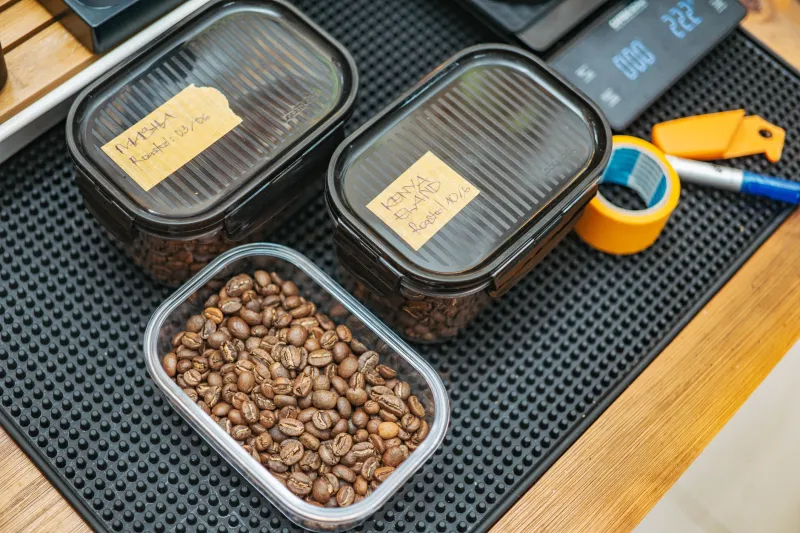
There is a quiet transformation happening inside every bag of specialty coffee sitting on your kitchen counter. The beans look the same from one day to the next. The aroma may seem consistent. Yet the cup you brew on day three after roast can taste strikingly different from the one you brew on day fourteen — and understanding why is one of the most practical skills a coffee enthusiast can develop.
At Discover Maruyama Coffee, we believe that sourcing exceptional beans is only the beginning. Brewing with intention means knowing not just how to extract flavor, but when.
The Invisible Clock: CO2 and the Degassing Process
Immediately after roasting, coffee beans are alive with carbon dioxide. During the roasting process, heat drives CO2 into the cellular structure of the bean, and once the beans cool, that gas begins its slow migration outward — a process known as degassing.
For the brewer, this matters in two significant ways. First, excess CO2 can interfere with extraction. When you pour hot water over freshly roasted grounds, the escaping gas creates a barrier between water and coffee solids, limiting how effectively flavors are dissolved. This is why brewing coffee within 24 to 48 hours of roast often produces an uneven, underdeveloped cup — not because the coffee is poor quality, but because it is simply not yet ready.
Second, degassing is a useful signal. That dramatic bloom you see when hot water first contacts your grounds — the swelling, bubbling dome of coffee — is CO2 escaping rapidly. A vigorous bloom indicates freshness. A flat, listless bloom suggests the gases have already dissipated and the beans may be past their prime.
For most single-origin coffees, the sweet spot for brewing begins somewhere between five and fourteen days post-roast, depending on the origin and roast level. Lighter roasts, which retain more cellular integrity, often benefit from a slightly longer rest period before they open up fully.
Oxidation: The Gradual Thief of Flavor
Once CO2 has largely escaped, oxygen becomes the primary agent of change. Oxidation is the same process that turns a cut apple brown or causes cooking oil to go rancid — and it works on coffee with similar efficiency.
The aromatic compounds responsible for the most nuanced flavors in specialty coffee — the floral high notes in an Ethiopian Yirgacheffe, the stone-fruit brightness in a washed Kenyan — are volatile by nature. They bond readily with oxygen molecules, and once oxidized, they lose the chemical structure that makes them perceptible to your palate. What remains tends to skew flat, papery, or vaguely stale.
This is why the storage environment matters enormously. Exposure to air accelerates oxidation dramatically. A bag left open on the counter may degrade noticeably within two to three days. Even a properly sealed bag will eventually succumb, as trace oxygen inside the packaging continues its work.
Practical Storage: What Actually Works
Given what we know about CO2 and oxidation, the principles of good coffee storage become intuitive.
Use an airtight container. This is the single most impactful step most home brewers can take. Ceramic or stainless steel containers with airtight lids are preferable to the original bag once it has been opened, as many retail bags — even those with one-way valves — are not designed for repeated resealing.
Keep beans whole until brewing. Ground coffee has exponentially more surface area exposed to oxygen than whole beans. Grinding immediately before brewing is not a matter of ritual — it is chemistry.
Avoid the refrigerator. Despite common intuition, refrigerating coffee is generally counterproductive. The moisture and odor absorption that occurs in a refrigerator environment can introduce off-flavors and accelerate staling. The freezer is a different matter: for long-term storage of beans you do not plan to use within two to three weeks, a well-sealed, moisture-proof freezer bag can preserve freshness reasonably well. Allow frozen beans to come fully to room temperature before opening the bag to prevent condensation.
Store away from heat, light, and humidity. A cabinet away from the stove or a pantry shelf is ideal. Countertop storage near a window or beside a heat source is among the worst environments for coffee.
Recognizing Beans Past Their Peak
Even with careful storage, all coffee has a finite window of optimal flavor. Learning to recognize when beans have moved beyond that window helps you make better purchasing decisions and adjust your brewing expectations accordingly.
Signs that coffee has staled include a flat or absent bloom during brewing, a noticeably muted or one-dimensional flavor in the cup, a cardboard or papery aftertaste, and an aroma that smells faintly musty or simply dull when you open the bag. Fresh specialty coffee should smell vibrant and complex even before it touches hot water.
For the single-origin coffees that define Maruyama's approach to sourcing — beans that carry the specific character of a hillside farm in Colombia or a cooperative in Rwanda — the stakes of timing are particularly high. These coffees are selected precisely because they express something distinct and traceable. Brewing them past their peak is not catastrophic, but it does mean you are tasting a diminished version of what the farmer and the roaster intended.
Matching Brewing Windows to Origins
Not all coffees behave identically through the aging process. As a general framework:
- Washed African coffees (Ethiopian, Kenyan, Rwandan) tend to be highly aromatic and volatile. Their most expressive window is often between 7 and 21 days post-roast. Brew them promptly.
- Natural and honey-processed coffees often carry more body and fruit-forward sweetness that can persist slightly longer, sometimes remaining vibrant through 4 to 5 weeks post-roast.
- Central and South American single-origins vary considerably by processing method, but many reach a pleasant equilibrium between 10 and 25 days post-roast — long enough for CO2 to settle, early enough for aromatics to remain intact.
These are starting points, not rigid rules. The best approach is to brew the same coffee at different intervals and pay attention to how the cup changes. That kind of intentional observation is at the heart of what it means to truly discover coffee.
Buying Smarter, Brewing Better
With this understanding, a few practical habits can meaningfully improve your daily cup. Purchase coffee in quantities you will consume within two to three weeks. Seek out roasters — like Maruyama — who print the roast date clearly on the bag, and treat that date as functional information rather than decoration. Resist the impulse to buy in bulk unless you have a reliable freezer storage system in place.
Freshness is not a marketing concept. It is a measurable, chemical reality that shapes every sensory aspect of the coffee in your cup. When you brew with awareness of that reality, you are no longer simply making coffee — you are engaging with it.